
The Shihou Kama Tsugi (しほうかまつぎ) showcases the remarkable craftsmanship of Japanese carpentry, where the joint’s complex three-dimensional form fits together with geometric precision. This “impossible joint” relies on carefully aligned angles and interlocking components, seamlessly merging mechanical strength with visual harmony in architectural design. Drawing by E.A. Kaas.
Chapter 5
How Could Form and Function Co-evolve?
Shape clay into a vessel; it is the space within that makes it useful. cut doors and windows for a room; it is the holes which make it useful. therefore, benefit comes from what is there; usefulness from what is not there.
Abstract
The previous chapter revealed how criminal networks exhibit hysteresis effects even with static network structure. However, real-world complex systems rarely maintain fixed topologies - instead, their structure and dynamics co-evolve over time occupying the negative and positive voids to create the whole. While research often separates network dynamics from node states to simplify analysis, this chapter examines how network structure and node states simultaneously shape and influence each other. We show how this co-evolutionary perspective reveals new mechanisms of system resilience and adaptation that emerge from the dynamic interplay between form and function.1
In complex systems, dynamics on a structure can yield unexpected outcomes, making it challenging to determine where and when to intervene. Typically, studies of static graphs focus on their dynamical properties, assuming a clear time-scale separation between structural changes and temporal evolution. However, many real-world systems exhibit dynamic reorganization over time, as seen in the maturation of neural networks where connections co-evolve with the system’s behavior. This chapter revisits the context of organized crime, building upon the model developed earlier (Chapter 4) to explore how the structure and dynamics of these groups interact and adapt.
“United we stand, divided we fall” [181] suggests a principle observed across various scientific domains of the need to coordinate or cooperate. From single-cell organisms [182], [183], [184], [185] to human societies [186], [187], collective action walks a tightrope between benefits derived by individuals and the cost required for coordinated interactions [188], [189], [190], [191].
Networks are used to describe interactions between individuals, with standard interactions including cooperation and coordination, in which individuals often pay a cost to benefit others [192]. The conditions for the evolution of cooperation between identical individuals and their connections have been studied using evolutionary game theory [189], [192], [193], [194], [195], [196]. However, individuals are often not identical in their function.
Selective pressures in collaborative networks drive the emergence of specialized roles, as entities optimize their resource allocation through complementary functions rather than redundant capabilities[197], [198], [199], [200]. The resulting complementary roles foster coordination and generate synergistic benefits that evolve to occupy unique niches, each contributing to the collective benefit while optimizing their cost-benefit ratios. These are evident in ecological mutualisms [201], [202], social sectors interaction [153], [203] international trade organizations, and even the structure of clandestine networks [124], [204], [205], [206]. Role differentiation has become a cornerstone feature of these systems, driving their capabilities, efficiency, and resilience.
While the importance of multi-role coordination in complex networks is well established, we lack a comprehensive understanding of how such systems maintain their robustness when adapting to external pressures over time. This gap is particularly evident in systems where the benefits of role specialization must be constantly balanced against increasing costs or risks. How do multi-role adaptive networks evolve to remain resilient under persistent external pressures? This question becomes especially relevant when examining systems that face continuous disruption attempts. Criminal networks offer a compelling example, as they consistently demonstrate remarkable robustness despite coordinated enforcement efforts to dismantle them.
Understanding how to disrupt multi-role networks effectively remains a significant challenge. Interventions can target different aspects of the system, from removing key individuals to disrupting specific relationships or increasing operational costs. Traditional approaches often focus on identifying and removing central actors [204], [207], disrupting specific roles [206], or targeting specific relationships [93]. Yet, the long-term impact of such interventions remains difficult to anticipate, particularly when networks can restructure their relationships and adapt their behaviors.
The limitations of current approaches to control highly adaptive criminal systems are illustrated by Operation Venetic. In 2020, this joint effort by law enforcement agencies from France, the UK, and the Netherlands resulted in more than 800 arrests [208]. However, just months later, Dutch authorities reported massive narcotics seizures in Rotterdam [209], with rates remaining high [210], while UK drug markets quickly rebounded to record levels [211]. Despite significant intervention, this rapid recovery highlights the urgent need for co-evolutionary models that capture how multi-actor systems evolve in response to external pressures.
We develop and empirically validate a dynamic model of multi-role networks using unique police intelligence data from Dutch criminal organizations. We explicitly capture how entities simultaneously adapt both their behavior and social ties in response to changing costs and benefits. The co-evolution of network structure and individual strategies reveals fundamental mechanisms of network resilience to an array of interventions, applicable across systems from ecological networks to international trade. Then, we calibrate the model with real-world data and demonstrate the bounce-back effects of different interventions.
The analysis reveals several counterintuitive findings about network evolution and resilience. Contrary to conventional wisdom, increasing network connectivity can destabilize the system. Even though they may increase total potential gains, conditions leading to high link density can shift the equilibrium from a high criminal state to one with minimal criminal activity by amplifying risks relative to potential rewards. Further, we should how interventions that cannot fully disrupt the system lead to temporary increases in performance. These results challenge traditional assumptions about how network disruption affects system stability, suggesting that interventions reducing connections between individuals might actually promote activity growth under low-density conditions.
From Theory to Ties: Understanding Criminal Network Evolution via Cost-Benefit Modeling
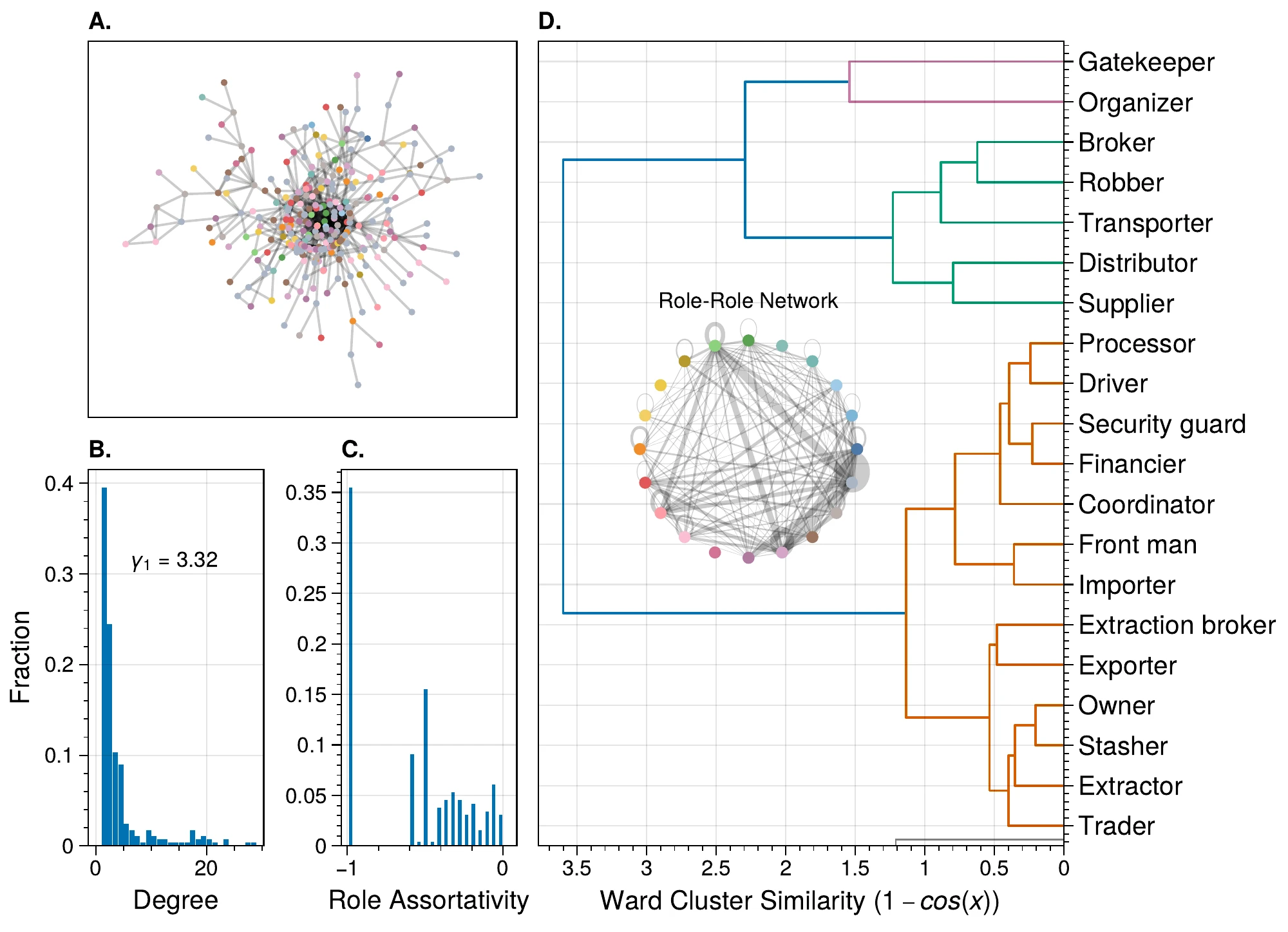
The Netherlands serves as a crucial gateway for drug trafficking into Europe [212]. The analysis of criminal organizations in the Netherlands reveals networks structured around specialized roles, with a primary focus on illicit drug markets and their associated logistics (Figure 5.1). These organizations exhibit strategic sparsity in their connections, characterized by a right-skewed degree distribution (skewness , Figure 5.2).
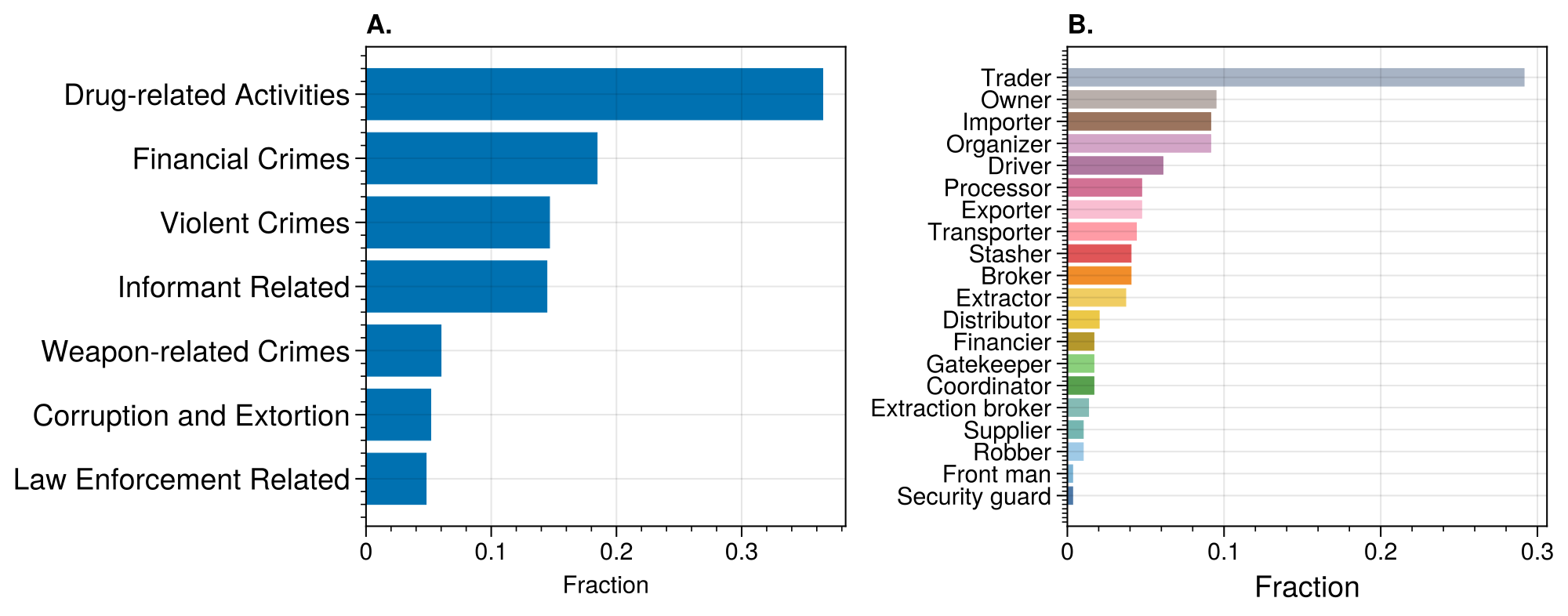
The data shows that criminal actors often possess multiple specialized skills, with individuals holding between one and nine distinct roles across different criminal markets. Using information theory principles, we measure how informative each role is in characterizing an individual’s criminal activities. For example, while ‘trader’ is a common role, its frequent occurrence makes it less informative in distinguishing between individuals. In contrast, a combination of roles like ‘trader’ and ‘electrician’ carries more information, as specialized roles like ‘electrician’ are rarer and, therefore, more salient in characterizing an individual’s position in the network. This quantitative approach reveals that individuals strategically form connections with complementary roles while minimizing redundant connections, as evidenced by the negative role assortativity in their ego networks (Figure 5.2).
We identified a reduced set of 20 role patterns from the initial set of 99 unique combinations of roles (Figure 5.2, see Section E.III). This data-driven approach reveals three distinct functional groups: transport (pink), logistics (orange), and management (green), collectively spanning the entire production chain.
The data can be clustered to produce a intuitive taxonomy of “who-knows-whom”. Three distinct groups can be identified that can be broadly characterized as transport, logistics and management. The majority of criminal of criminal organizations in the Netherlands are involved in illicit drug-trade, and the Netherlands is informally known as the gateway to Europe for drug trafficking.
Drawing from the empirical data and the broader literature on collaborative networks, we conceptualize criminal organizations as complex adaptive systems operating under business-like principles. The model represents these organizations as multi-agent networks where individuals make strategic decisions based on local interactions and cost-benefit analyses. Each agent evaluates the potential payoff of criminal activities against associated risks, with their decisions influenced by a cost-to-benefit ratio. To capture real-world uncertainties, we incorporate a decision error parameter, reflecting the imperfect information and cognitive limitations faced by individuals in these networks.
Formally, agent chooses its strategy based on the payoff
(5.1) where represents all organizations agent could form with its nearest neighbors and their neighbors, is the set of all roles required to form a complete organization, is the state of agent in organization having role , is the cost of being visible in the network. The agent considers changing their current strategy with another with probability:
(5.2) where is the decision error (see Methods \& Data for further details).
In each simulation step, the agent chooses with probability whether to consider updating their connectivity by removing or adding new edges, or to update their strategy based on the payoff function. This places the model within the sparsely studied field of complex adaptive systems in which both the strategy as well as the network co-evolves – a key aspect of many real-world systems. Furthermore, it naturally extends a former study on criminal organizations [116] or see Chapter 4.
This minimal model introduces a tension between the potential benefit of forming criminal organizations with the associated risks such as apprehension through law enforcement. Furthermore, it emphasizes the dissortativity by explicitly accounting for role-to-role dependency a kin to a regular business or synergetic relationship.
Multi-stability and Path Dependency
The computational model builds upon the empirically identified roles to explore the dynamics of criminal organization formation. In the model, agents make strategic decisions about both their criminal involvement and network connections based on their roles, and the roles and states of whom they are connected to. This approach allows us to study network configurations and criminal behavior patterns beyond those observed in the empirical data. Agents evaluate the trade-off between potential benefits and risks of criminal activity under uncertainty, parameterized by . We analyze how the system’s behavior varies with both the cost-benefit ratio () and decision uncertainty (), which jointly shape agents’ utility calculations and decision confidence.
We show the coevolution of the fraction of criminals, denoted as criminality, roles, and network link density. In Figure 5.3, we observe the presence of different possible dynamics not only across parameters but within the same parameter set for different initial conditions.
[h!] 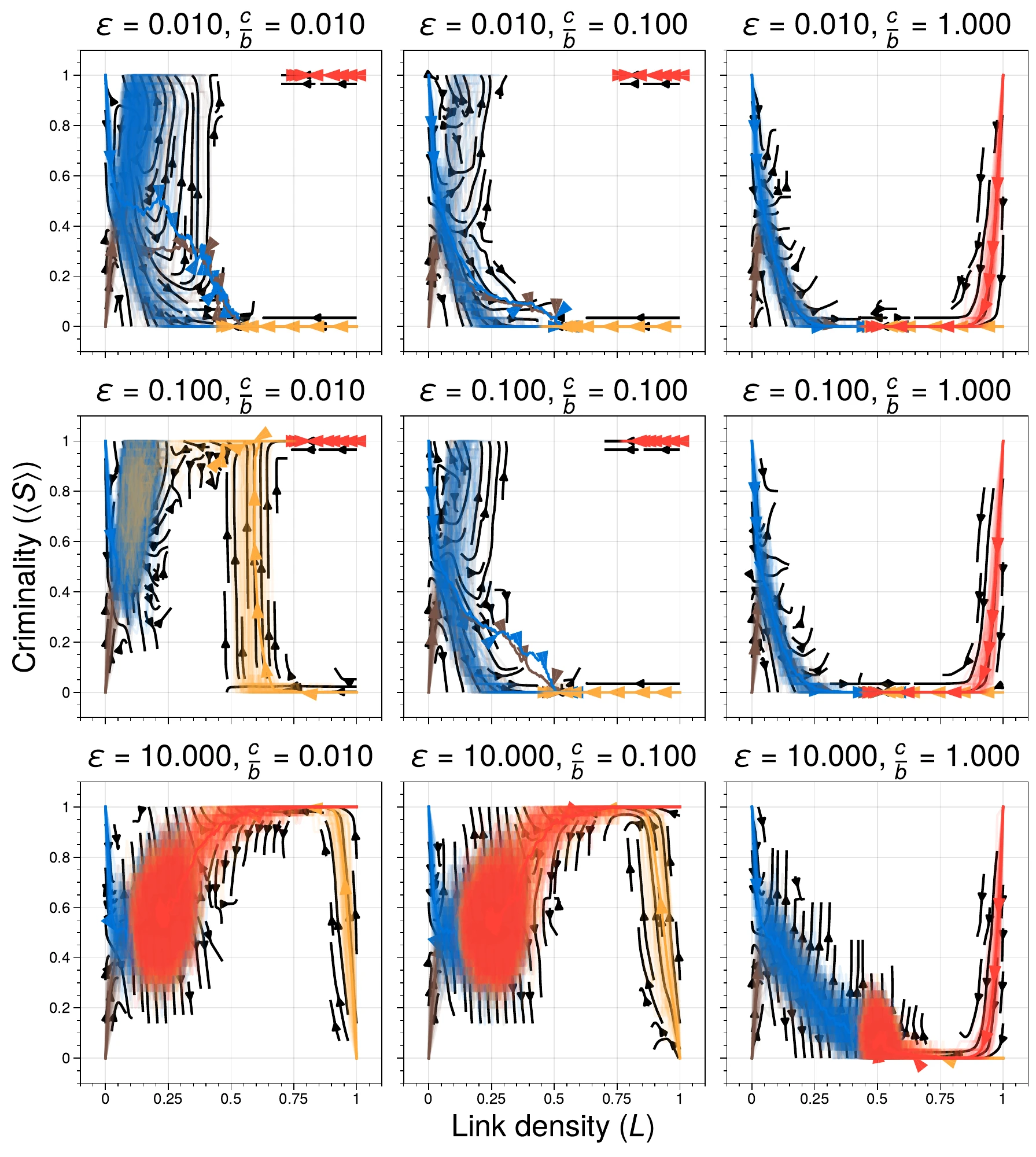
When the cost-benefit ratio () and the decision error () are low, multiple dynamic attractors are possible with different levels of stability: i) a high criminality-high density attractor, ii) a low criminality-high density attractor, and iii) an intermediate criminality-low density attractor, each with increasing stability and accessible via different initial conditions. Starting from full connectivity (), the networks preserve high interconnection among nodes. In contrast, still starting with all agents adopting criminal strategies but with zero connections () results in high criminality but low link density. Non-criminal initial states () tend to form random networks with a fixed link density, in this case 50% given the neutral reference payoff of non-criminal actions.
There is a critical threshold for initial link density corresponding to the density of the non-criminal network () that determines whether a criminal organization can form when the cost-to-benefit and decision error approach zero. This threshold plays a crucial role in shaping the emergent network structures.
A single attractor exists for high uncertainty, with higher costs leading to higher link density and lower criminality. The level of success of these organizations depends on the specific cost-benefit and uncertainty.
[h!] 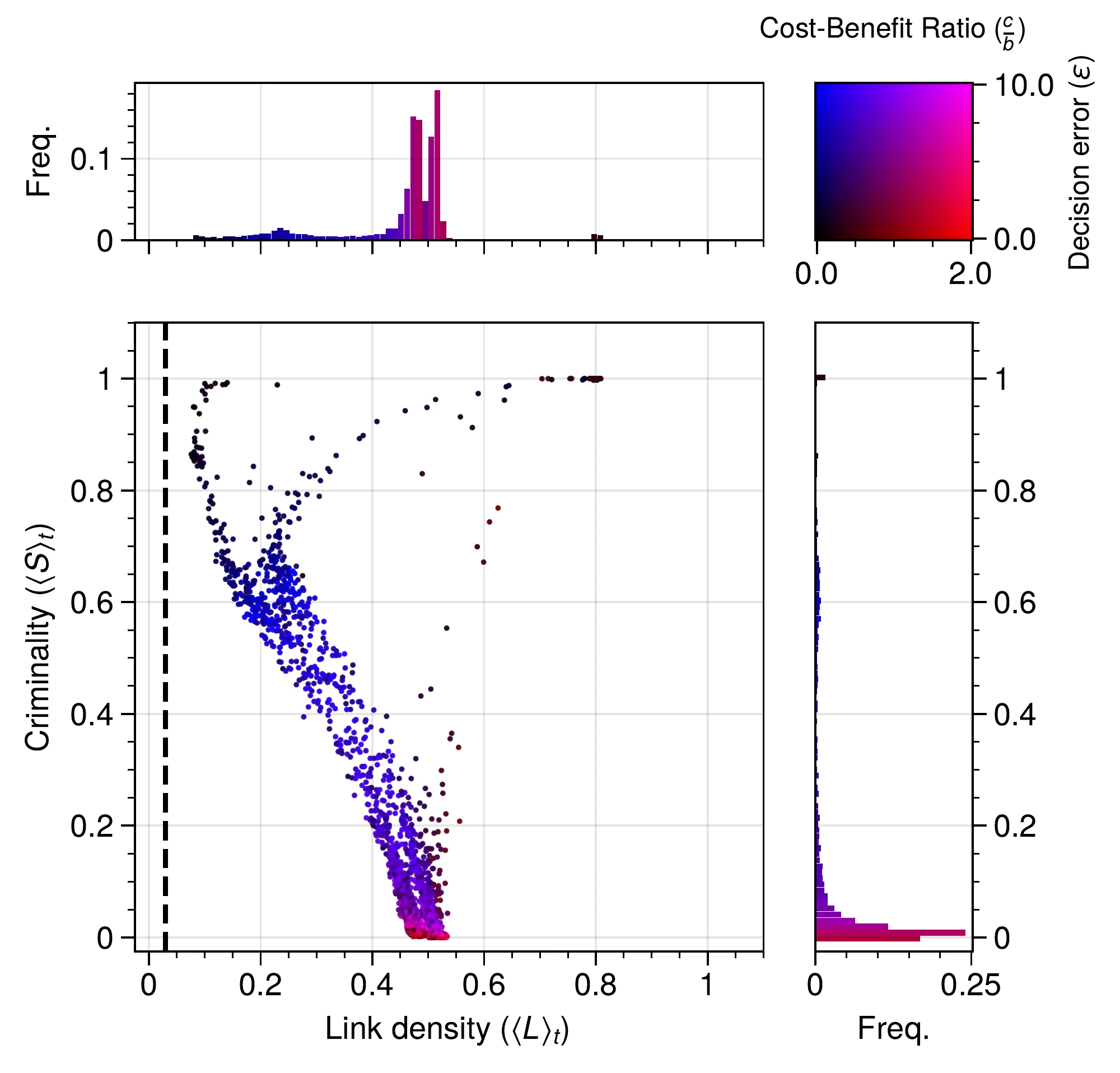
Figure 5.4 shows, across all parameters settings, how the success or failure of these organizations depends on the considered external factors of cost-benefit and uncertainty but can also be non-unique and sensitive to the system’s initial state.
The emerging networks vary beyond their link density. Figure 5.5 illustrates the distinct network structures emerging across cost-to-benefit ratios in a PCA considering an array of network properties, including link density, clustering coefficients, and degree entropy (see Figure E.VIII.2 for the different properties of the emerging networks). High cost-benefit ratios () result in sparse, fragmented organizations (link density , clustering coefficients ). Low ratios () lead to denser networks with wider degree distributions (degree entropy ) and higher average clustering (), indicating decentralized, hub-spoke structures. These patterns align with empirical observations of clandestine networks [213], where organizations develop increasingly well-connected structures around key actors when preparing for operations, suggesting similar strategic adaptations in network structure based on operational conditions.
Now that we understand how network structures emerge from different cost-benefit ratios and decision uncertainties, we analyze how these adaptive networks respond to interventions. Using the Dutch Police data, we calibrated the model parameters to reproduce observed network structures (see Section E.IV).
There’s a critical threshold for initial link density () that determines whether a criminal organization can form when cost-to-benefit and decision error approach zero. This threshold, along with the cost-to-benefit ratio, plays a crucial role in shaping the emergent network structures.
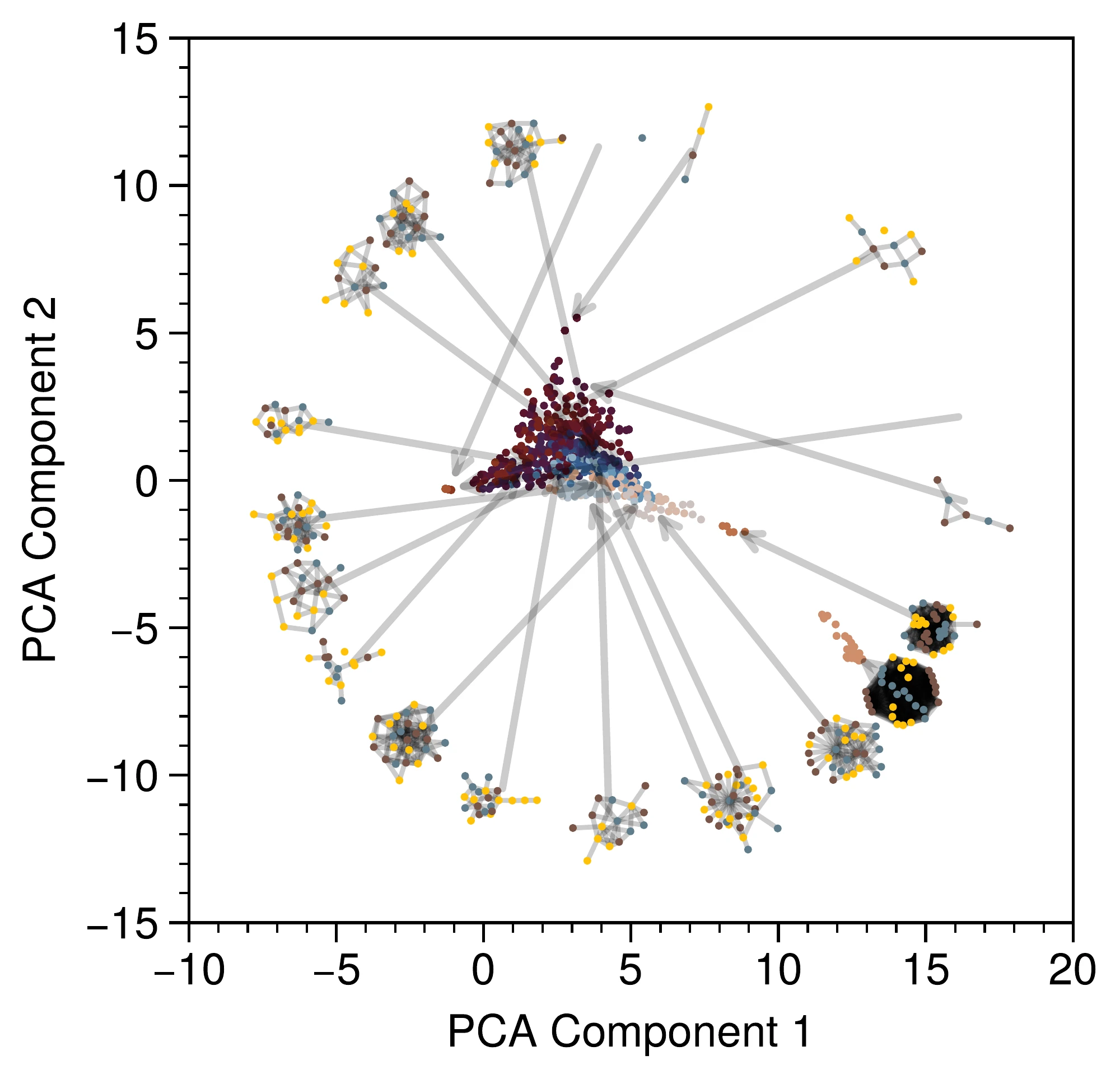
Further simulations reveal distinct network structures emerging under different cost-to-benefit ratios (Figure 5.5 and Figure E.VIII.2). High ratios () result in sparse, fragmented organizations (link density , clustering coefficients ). Low ratios () lead to denser networks with wider degree distributions (degree entropy ) and higher average clustering (), indicating decentralized, hub-spoke structures. These patterns align with real-world observations of criminal network adaptations under law enforcement pressures whereby a reduction is visibility follows increased pressure, and an increase in density is observed prior and after a potential attack [213].
Paradoxical Effects of Interventions on Criminal Networks
We systematically evaluated criminal network resilience by simulating three distinct law enforcement strategies: reintegration (increasing agent connectivity through social programs), arrests (isolating agents from the network), and informant recruitment (converting criminal agents to non-criminals while the criminal state of their connections remains the same).
While we extensively tested these interventions across all parameter combinations (see Section E.VI), we focus here on the calibrated parameter set that reproduces empirical network structures (Figure E.IV.1, with fixed ). These optimized parameters suggest that criminal organizations in the Netherlands operate with moderate decision uncertainty and face relatively low costs compared to benefits. The high decision error implies considerable mixing between different roles, while the low cost-to-benefit ratio indicates favorable conditions for criminal activities. The model achieves equilibrium networks matching empirical patterns, even with unrestricted rewiring possibilities.
To better reflect real-world constraints, we then restricted agents’ rewiring options to local connections (neighbors and neighbors of neighbors), limiting their access to global information. The analysis reveals intervention outcomes that often contradict intuitive expectations.
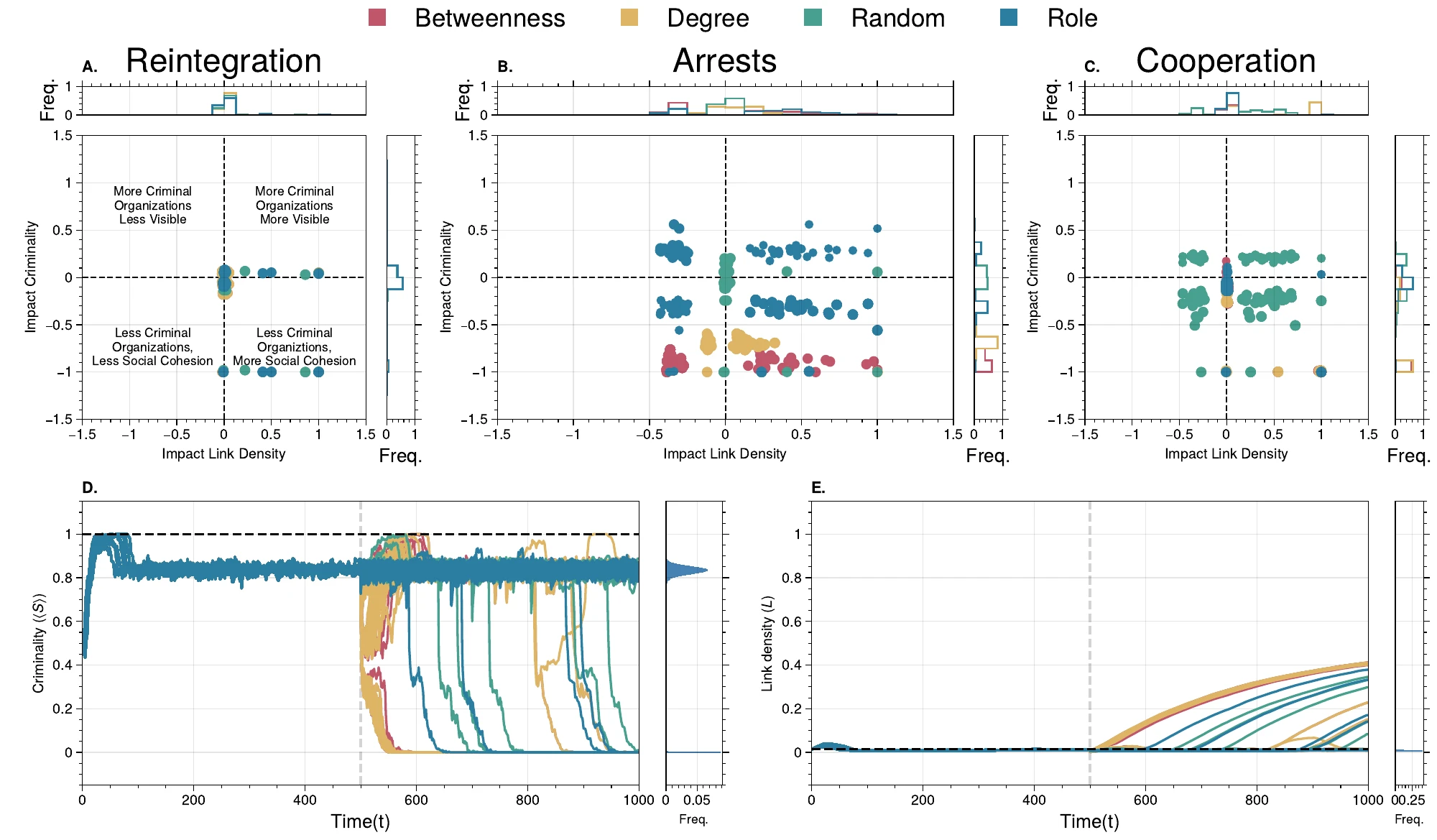
Criminal networks show varying levels of adaptation post-intervention (Figure 5.6, top panels). Many networks recover to their pre-intervention state, particularly under reintegration strategies and random arrests. However, role-based arrests and random cooperation produce symmetric deviations from baseline criminal activity, both increasing and decreasing criminality levels. The most effective interventions for reducing criminal activity are arrests targeting agents with high betweenness centrality and degree-based cooperation strategies. While these findings align with previous research on criminal hierarchies [204], The results imply an unexpected pattern: informant recruitment achieves optimal outcomes through random targeting, suggesting criminal networks actively reconfigure roles to maintain resilience.
The co-evolution of these networks shows substantial variability in their post-intervention states, with criminality levels fluctuating up to 50% from baseline levels (see Figure 5.6D)."
Temporal analysis for the calibrated model revealed complex dynamics. Starting from random configurations that match the density of the empirical network, the simulations demonstrated an initial spike in criminal activity followed by a density adjustment (Figure 5.6 D,E). Although betweenness-based arrest strategies initially reduced both criminality and network density, these effects proved transient, highlighting the network’s adaptive capabilities. When the criminality diminished, the density of the links increased as the non-criminal population approached an Erdős-Rényi configuration (). This transition manifested specifically when interventions successfully disrupted the criminal character, resulting in more cohesive but less criminal network structures. The intervention-specific nature of reduced criminality was validated by the absence of such outcomes in pre-intervention simulations.
The analysis reveals a fundamental tension between network disruption and criminal activity reduction. Strong interventions often triggered compensatory adaptations, leading to increased network resilience. These findings demonstrate that effective and long-term disruption requires sophisticated, systems-based approaches that anticipate and account for the networks’ adaptive responses.
Structures in Motion: How Form and Function Shape Adaptive Criminal Systems
The study explores how individual decision-making processes, driven by cost-to-benefit trade-offs and decision certainty, shape the dynamics and collective action in highly adaptive networks, with implications for diverse complex adaptive systems. The observed path dependencies effect demonstrates how initial conditions and external pressures profoundly influence network stability and resilience even in heterogeneous adaptive systems. The observed dynamics between network connectivity and node state highlight a general principle in multi-role coordination systems: functioning that requires balancing collaborative benefits against structural vulnerabilities is robust to various perturbations.
Particularly striking are the paradoxical effects of interventions on criminal networks. We find a “criminal opacity amplification,” where targeted disruptions can increase overall criminality while reducing network visibility. This effect challenges conventional law enforcement strategies. It emerges through fragmentation and adaptation, creating more decentralized and fluid criminal landscapes that defy traditional countermeasures. The decrease in link density opens the organization up for potential future attacks; however, it can also make it more difficult for law enforcement to track the organization.
The co-evolutionary model captures a dynamic security-efficiency trade-off that static network analyses often miss but is often referred to in literature [116], [124], [132], [204], [205], [207]. The ability of criminal networks to reconfigure in response to external pressures mirrors adaptive behaviors observed in legitimate organizational structures and ecological systems. This flexibility principle likely underlies the resilience of many complex collaborative systems, both beneficial and harmful.
While the study focuses on criminal organizations, the insights gained have broader implications for understanding complex adaptive networks across various domains. The model formulates how networks balance different strategies under external pressures, revealing universal principles of adaptive behavior. These insights could inform the design of resilient business structures in volatile markets or guide the maintenance of biodiversity in ecological networks. The key contribution lies in understanding how adaptive networks respond to interventions—a dynamic that cannot be captured through static network analysis alone.
Despite these promising applications, we acknowledge limitations in the current model. In particular, the model treats all role-to-role interactions as equally weighted and bidirectional, whereas real criminal networks likely exhibit asymmetric relationships between roles. For instance, leadership roles typically exert directional influence over subordinate roles rather than vice versa.
This study represents a rare integration of empirical criminal network data with adaptive agent-based modeling, addressing a theoretical gap in complex adaptive systems but a critical gap in criminological research where data-driven computational approaches remain underutilized. By revealing how local cost-benefit calculations drive emergent network structures, the work provides novel insights into criminal organization resilience that extend beyond traditional statistical analyses. The demonstrated relationship between individual strategic choices and collective adaptation offers valuable insights for policymakers and law enforcement agencies seeking to disrupt criminal networks.
More broadly, the findings in this chapter contribute to the science of complex adaptive systems by quantifying how targeted interventions can produce counterintuitive outcomes through collective reorganization. This framework for analyzing system-wide responses to local perturbations has particular relevance for understanding organizational resilience, especially in contexts where traditional top-down control is limited or absent. These insights emphasize the critical importance of incorporating adaptive dynamics when designing interventions in complex social systems.
Despite these promising future applications, we acknowledge limitations in the current model, including simplified assumptions about role necessity and fixed roles throughout simulations. An important step forward would be to include role-to-role dynamics to get closer to a description of how multi-role coordination interfaces within the landscape of collaboration under external pressures. Future research should address these limitations by incorporating more nuanced, specific and applied multi-role coordination dynamics and role evolution over time.